

Modernizing Investment Bank CRM to enhance Customer Connectivity
Client : Barclays
Industry : Finance (Banking)
My Role : Service Designer
Duration : Oct 2025 - Apr 2026 (Phase 1)
Team : +5 Designers
Introduction
Barclays is a global financial service firm offering personal, corporate, investment banking, and wealth management services.
frog design partnered with Barclays to modernise its CRM platform (platform name redacted) by improving customer connectivity and streamlining employee workflows. The platform serves as the primary CRM system for Barclays investment bank, spanning across 4 Business Units i.e Banking, Markets, Research, and Corporate.
Objective
To transform the CRM platform that redefines how Barclays connects with its clients, streamlining workflows, enhancing usability, and driving intelligence across the 4 Business Units (BUs). frog Design-IN was briefed to particularly focus on the ‘Banking’ BU of the Platform for the first phase.
Impact
// Secured executive alignment across 2+ BUs, enabling rollout of the redesigned service model to 1,200+ internal users.
// Achieved 4/5 executive’s alignment on the design direction, enabling faster CRM adoption and next-phase approval.
Scope
Strategy & Concepts - Synthesize research insights to identify opportunity areas that shape the future vision. These insights will inform early concepts to enhance the UX across user groups.
Deliverables - UX Audit, Journey map, Vision & hero concept designs, Target tech capability Model/Gaps.
Prototyping & Plan - Refine concepts using stakeholder feedback, align them to key user journeys, and define the implementation plan, including prototyping, validation, and clear next steps.
Deliverables - Hero Prototype, Socialization/Pitch Deck, Next Steps Plan.
Context
Within the 4 BUs i.e (Banking, Markets, Research and Corporate) CRM users sit across a spectrum from Management to Contributor. For Management to do their job efficiently, regardless of the BU, there’s a heavy reliance on Contributors to use the CRM effectively. This creates a huge discrepancy in the efficiency of the task handled by the Management teams on the CRM portal.
Thus the Strategic frogNA team, conducted user research, understanding various JTBDs and Pain points for every persona of these 4 BUs to learn the cross-functional dependencies and obstacles.
Focusing on the Banking BU, the teams throughout the hierarchy, were not completely convinced and hence avoided using the CRM for all of their tasks as most still preferred using Excels to document and communicate. This was caused due to the lack of intuitiveness of the CRM portal which further caused the data to be scattered all over the team without having a single source of truth.
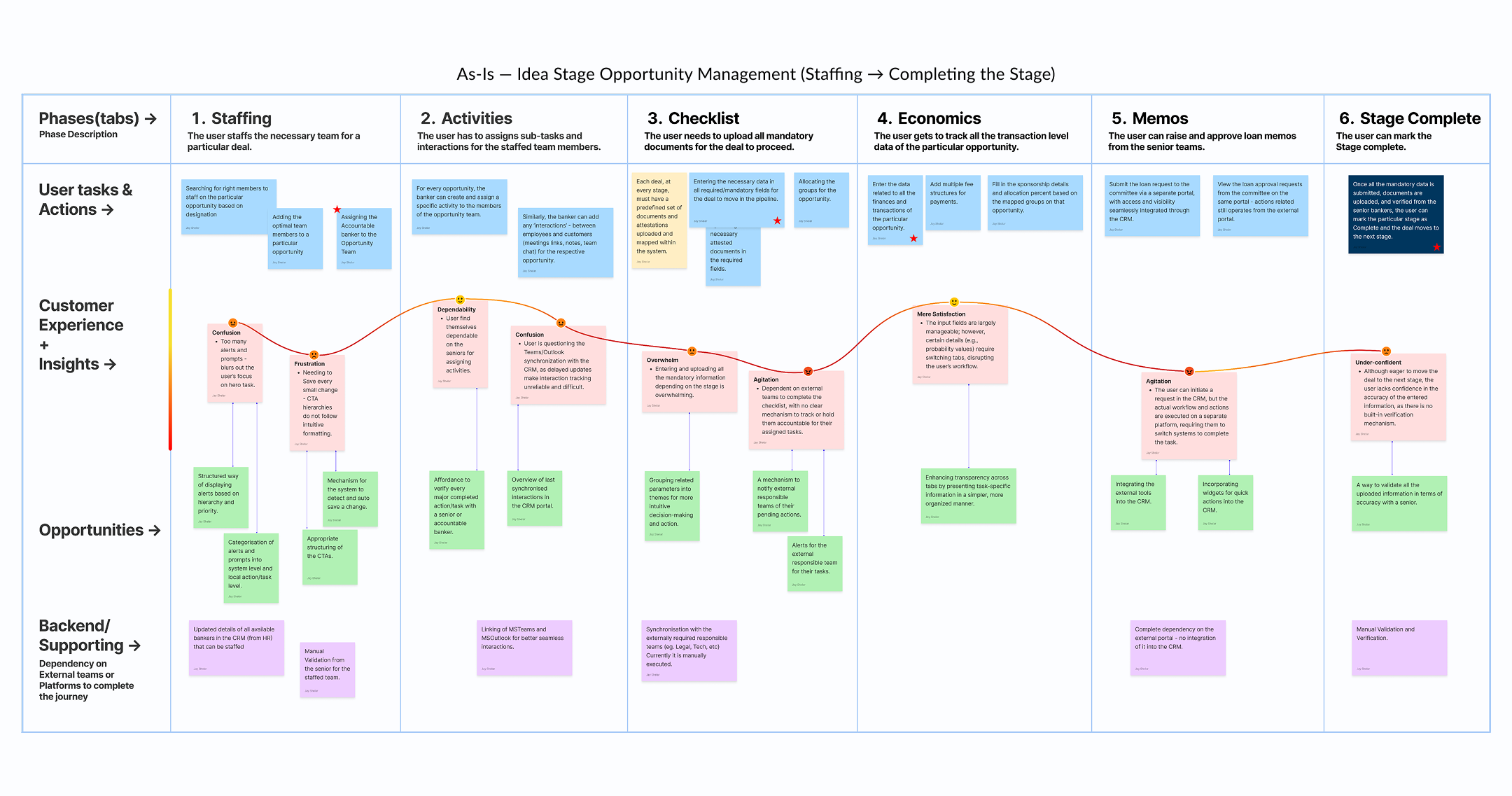
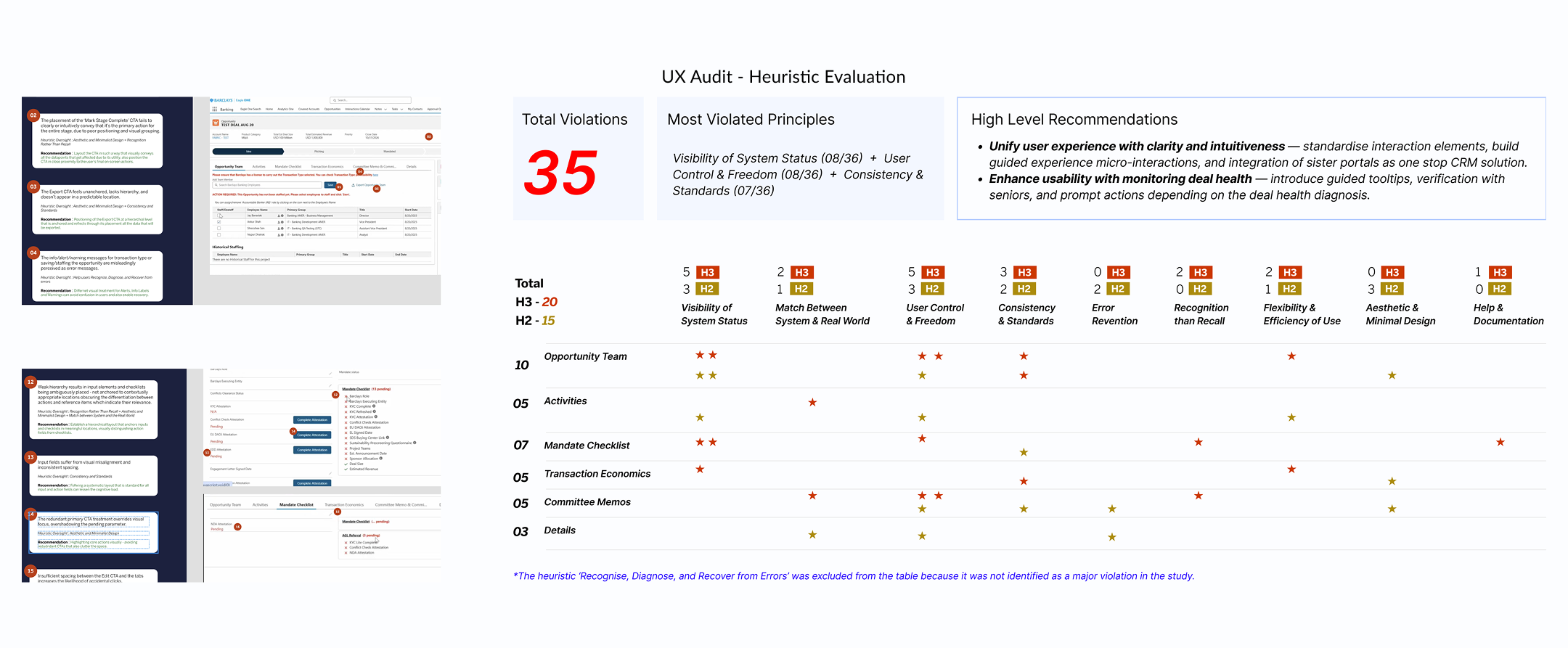
Based on the research documents, we also developed a Customer journey map to figure out the existing phases of completing an Opportunity and signing a Deal, whilst also simultaneously conducted a Heuristic Evaluation of the current CRM portal.
Challenges
01
Low Adoption & Perceived Low Value:
Contributors view opportunity creation as duplicative and non-value-adding, leading to minimal engagement, incomplete inputs, and reliance on non-CRM tools like Excel for managing opportunities and client data.
02
Poor Data Quality & Fragmented Processes:
Inconsistent and incomplete capture of critical client and opportunity information results in fragmented workflows, limited visibility, and suboptimal business outcomes.
So the question is…
How might we, reduce the duplication in opportunity creation and make the process more valuable and seamless for Banking Contributors to drive better engagement and outcomes?
To better understand the user's workflow, we drafted a customer journey map to capture the junior banker's motivations and pain-points.
Our Learnings
Based on the research, stakeholder interviews, the workshops mapping the existing process, and the heuristic evaluation, we were able to derive certain directions and insights on which we would be basing our Design Strategy on. These insights more or less, revolved around three key themes:
Assistance Throughout the Journey
Efficient cross-functional Collaboration and Verification
Deal Health Monitoring
We focused our Design Strategy based on the above three core themes.
What was our Design Strategy…?
To unlock the CRM value at Barclays, we identified the right incentives for Contributors to address Management’s objectives. We mapped expectations across business units, focusing on two areas: Opportunity Management (tracking new business) and Client Engagement (tracking interaction quality). Phase 1 prioritized improving the Opportunity Management workflow through four 2-week sprints.
Opportunity Management workflows were mapped to align with user needs and Management goals, focusing on three key flows:
adding/updating opportunities to forecast revenue,
auditing wins/losses to refine GTM strategy,
and identifying cross-BU opportunities to capture large-account revenue.
We identified gaps where contributor motivation and CRM capabilities were misaligned; either due to low engagement with existing features or unmet needs where functionality was incomplete. We recommended reimagining the CRM to better meet user expectations, leveraging two key levers to address the identified hurdles.
01
Through a focused Design audit, identifying friction in key tasks, we can drive immediate improvements to the overall user experience.
02
Ensuring consistent design patterns and elements enables users to predict interactions and reduces confusion.
This applies to visual elements (e.g., colour, buttons) as well as taxonomy and naming conventions.(catered by frog US team)
Enabling the strategy further with conceptualisation..
We mapped a diagram of possible directions of the solutions and categorised them into themes which we can further elaborate through our design solutions
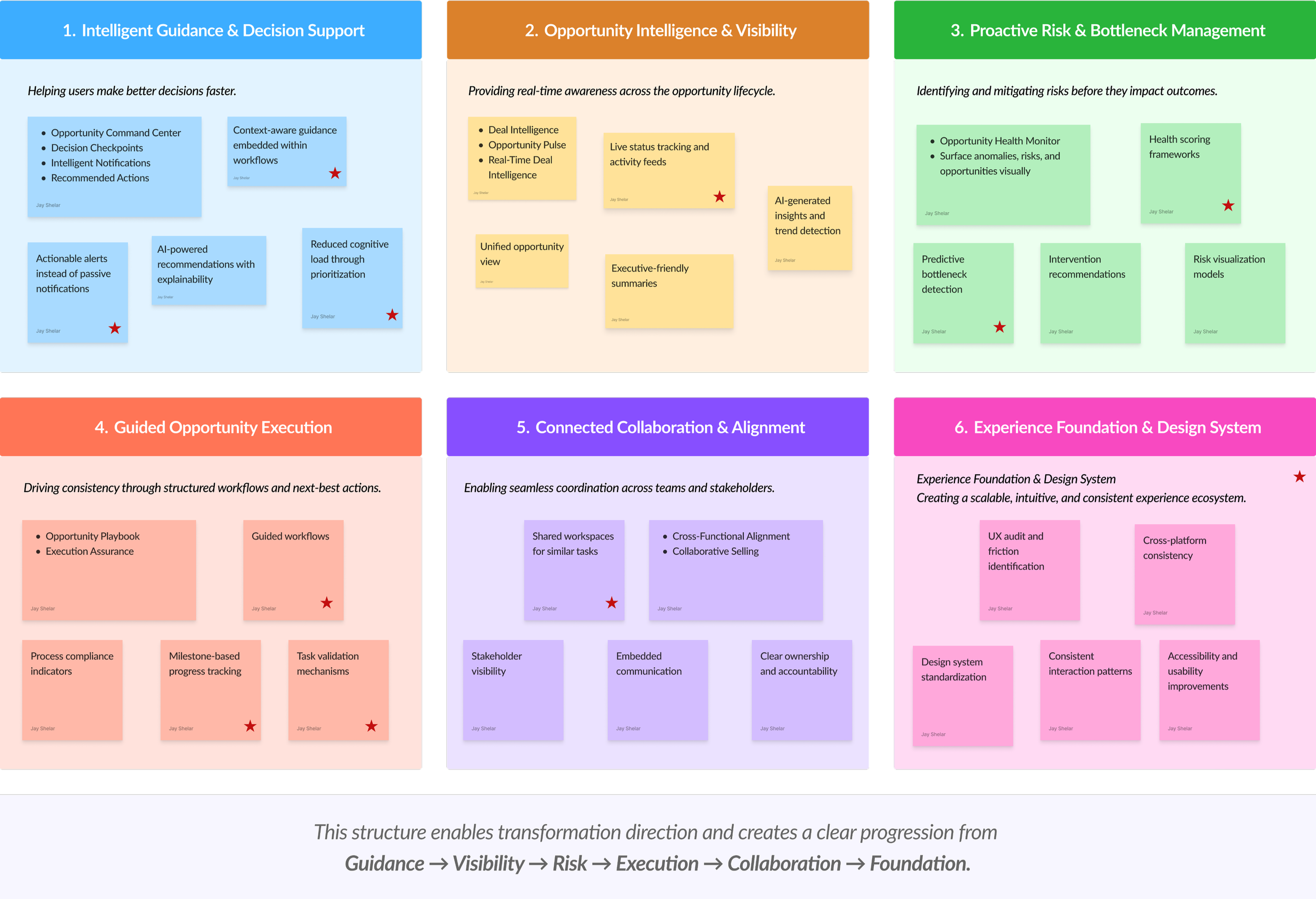
Although the portal revamp required a consistent visual identity (enabled by the frog-US team)the frog-IN team also focused on amplifying the overall experience. We introduced key strategic feature enhancements across the user journey to empower users and ensure their needs were effectively met.
Design Outcomes
01
Guided Journey Experience
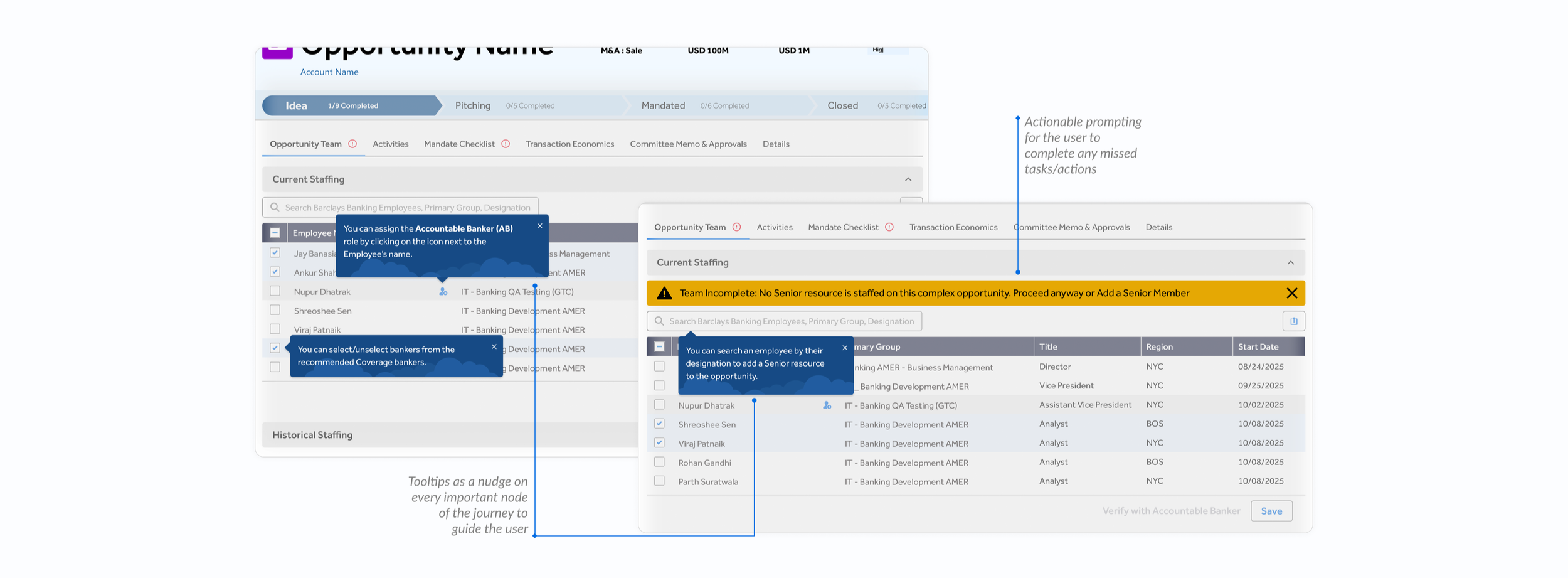
Pain point tackled
A junior banker who has created an opportunity needs to update the deal pipeline but cannot do so without relying on prior training.
→
Enabled through
Understanding process bottlenecks & introducing design elements that inform bankers with a step-by-step guide to completing the stage. It can intuitively prompt critical actions, giving validations and next steps for efficient progression of deal pipeline.
02
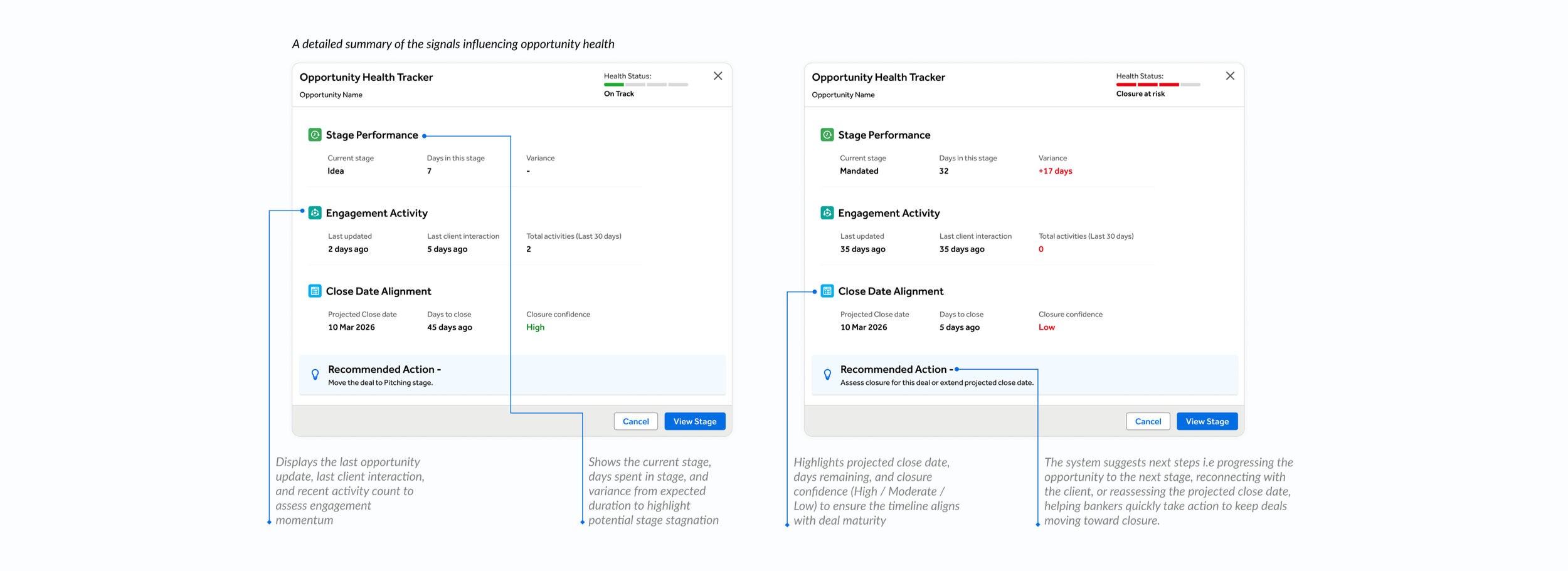
Opportunity Health Tracker
Pain point tackled
Valuable deal insights remain undocumented, as the CRM acts only as a recording tool & fails to capture pipeline bottlenecks or patterns. This limits strategic refinement and deprives leadership of data needed to drive improvements and win more business.
→
Enabled through
Introducing an API-driven feature that tracks opportunity health using key parameters (close date, revenue, probability) and highlights hurdles for action. A single-pane view which shows health scores, blockers, pending docs, and risk flags, enabling proactive, faster, and smarter deal management.
03
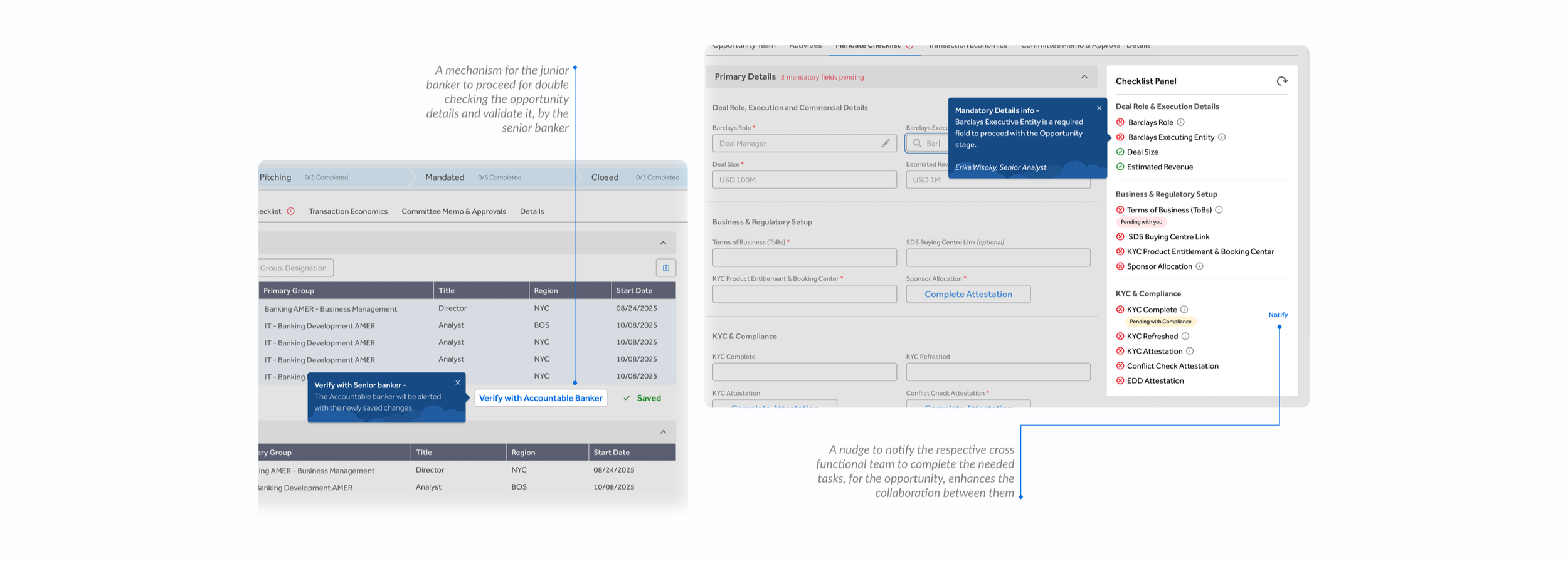
Collaboration & Validated Verification
Pain point tackled
Barclays’ siloed structure & CRM, discourage holistic account management, making cross-functional opportunity identification hard, leading to missed cross-sell opportunities.
”95% of how we cover clients should be collaborative, sharing information across the board. It’s the best way to win as a team“
- Banking’s, MD
→
Enabled through
Developing validated verification flows for each sub-workflow across the 3 opportunity stages (Idea, Pitching, Mandate) - from junior to senior banker - while building holistic CRM collaboration that defines and tracks team responsibilities hence driving ownership, transparency, and enhanced teamwork.
Impact of our Strategies
01
Top leadership buy-in and confidence enabled strategic impact
→ Aligned executive stakeholders across 2+ business units, enabling enterprise-wide rollout of the redesigned service model to 1,200+ users.
→ Leadership endorsement accelerated decisions by ~40%, allowing strategy-to-implementation within 1 quarter.
02
Executive support accelerated the improved CRM adoption
→ Executive sponsorship increased CRM adoption from 65% to ~82% active usage within first 1-2 months.
→ Improved data capture and workflow consistency, increasing pipeline visibility by ~21% and reducing manual reporting effort by ~17%.
This was a post-delivery ad-on that we created to showcase how our solutions could be taken a step further if they are enabled with AI agents or LLM backed models.
If AI enters the picture…
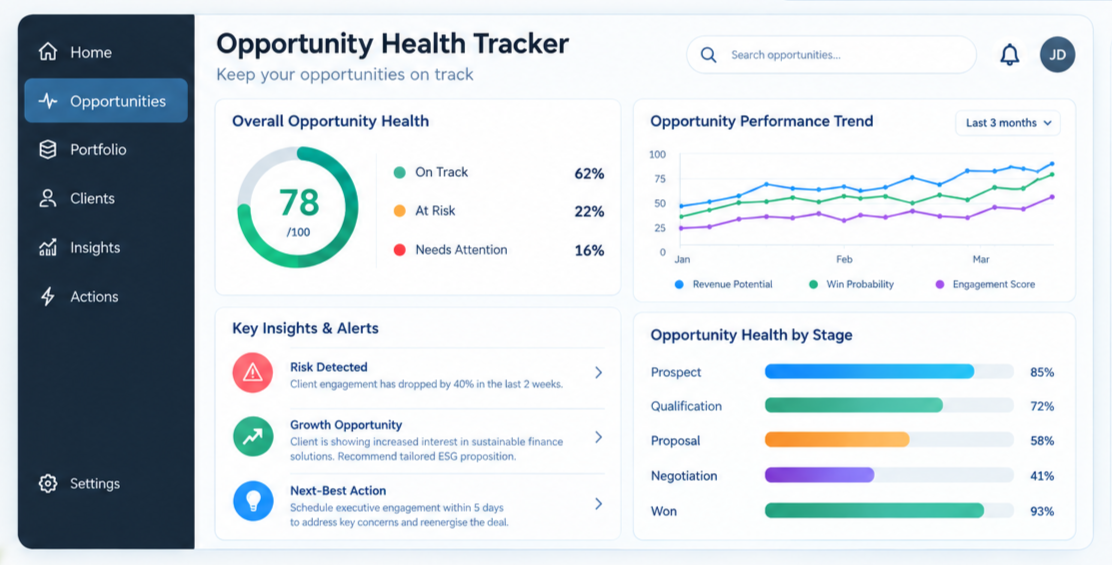
Health Tracker
Transforming the ‘Opportunity Health Tracker’ into an AI-powered decision support capability that continuously analyses opportunity performance across strategic KPIs, behavioural signals, and workflow patterns.
By proactively identifying risks, surfacing growth opportunities, and recommending next-best actions, the experience evolves from passive monitoring to intelligent guidance, enabling bankers to make faster, more informed decisions throughout the opportunity lifecycle.
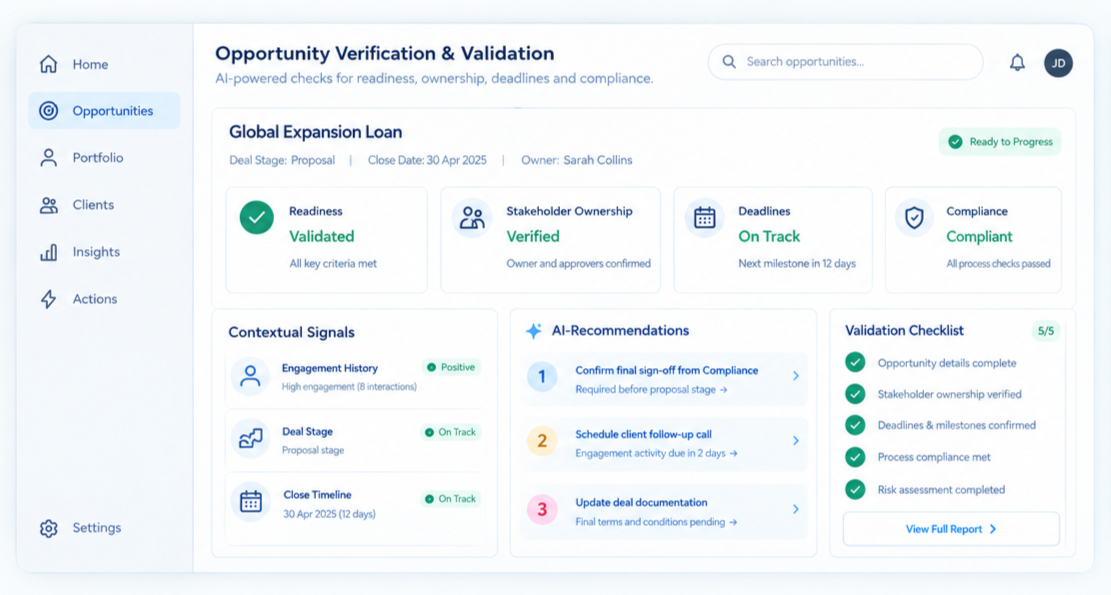
Verification and Validation
An embedded agentic intelligence layer that proactively validates opportunity readiness, verifies stakeholder ownership, deadlines, and process compliance, while surfacing prioritized actions based on contextual signals such as engagement history, deal stage, and close timelines.
By automating verification and governance checks, it empowers bankers to confidently progress opportunities without requiring escalation to senior stakeholders, improving execution speed, accuracy, and accountability.
More of my Work…

Researching SMB Workflows in India
Investigating Indian SMBs to identify critical business use cases needing digital interventions.

Digital Factory Transformation
Driving manufacturing with Service Design methodologies for intelligent diagnostics and optimized maintenance.