
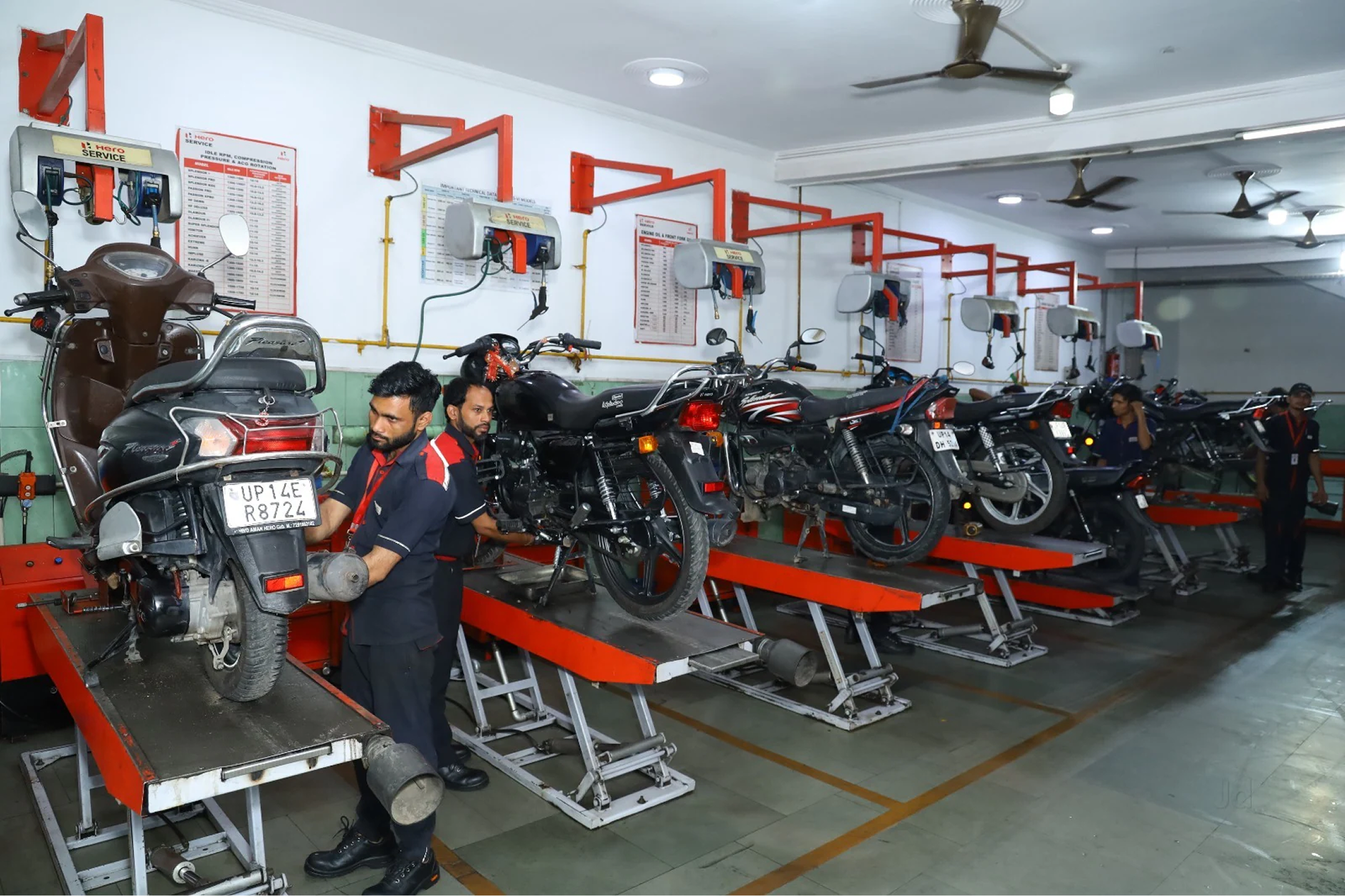
Optimizing Automobile Service station operations to Boost Efficiency, Accuracy, and Customer Engagement.
Client : Hero MotoCorp
Industry : Service Operations: Automobile (after-market)
My Role : Team lead - Service Designer : Designing holistic service architecture across frontline staff, technicians, & billing teams, defining the service strategies & journeys to enable more reliable service delivery.
Duration : Jun 2023 - Nov 2023
Team : +3 Designers
Introduction
Hero MotoCorp Limited, a leading Indian two-wheeler manufacturer, operates a nationwide after-sales network of over 6,500 dealers and service centers. Their stations currently face hurdles with processes being dependent on an outdated mobile app.
→ Our team initiated a transformative project to streamline service operations, enhance efficiency, and strengthen customer relations. We proposed a new Way of Working of vehicle servicing for optimized floor management.
→ The approach reimagines operational workflows for technicians & service executives. Designed for continuity, the newly designed framework aims to integrate with customer-facing apps to deliver a connected, high-quality, and streamlined service experience.
Objective
Enhance service efficiency and customer experience by reducing wait times, errors, and miscommunication through strategic technology enablement and process optimization. Increase revenue and elevate customer loyalty by systematically driving upselling, cross-selling, and value-added programs such as insurance and relationship initiatives.
Impact
Revenue outcome
Redesigned service journeys contributed to a 23% rise in after-sales registrations of cross-sell products.
Operational Efficiency
Re-vamped workflows reduced manual operation time from 10 minutes to 02 minutes per vehicle.
Lowered Process Errors
Enabling voice-recorded complaint modules decreased errors by an estimated 22–25%, enhancing service accuracy.
Scope
Conduct end-to-end research of service floor operations, identify pain points and bottlenecks, co-create and iterate strategic resolutions with stakeholders for a seamless on-floor service station management process.
Existing processes
Service stations currently rely on paper job cards and an early-stage mobile app to manage assignments, aimed to replace manual processes.
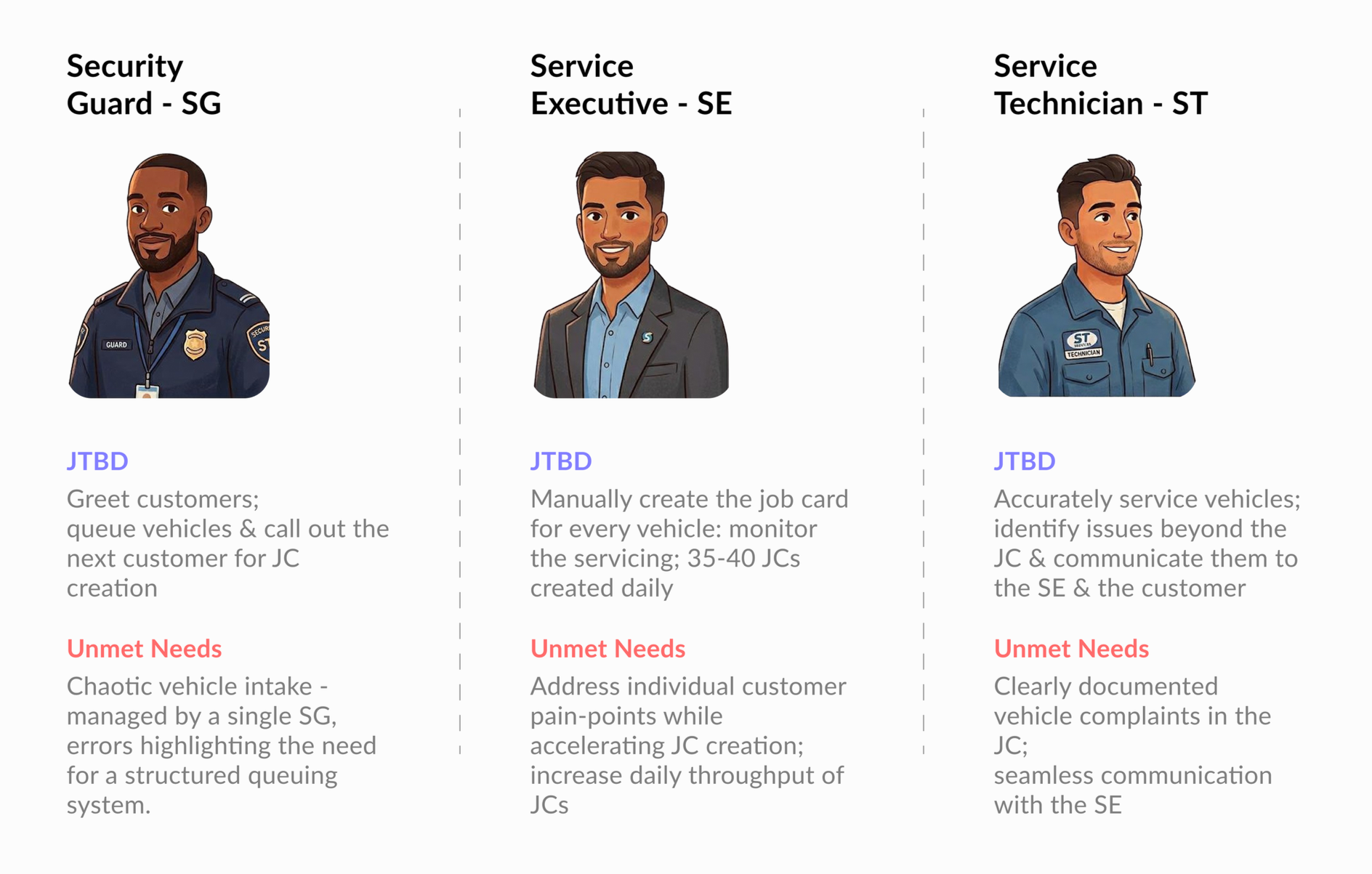
Actors of the existing service journey
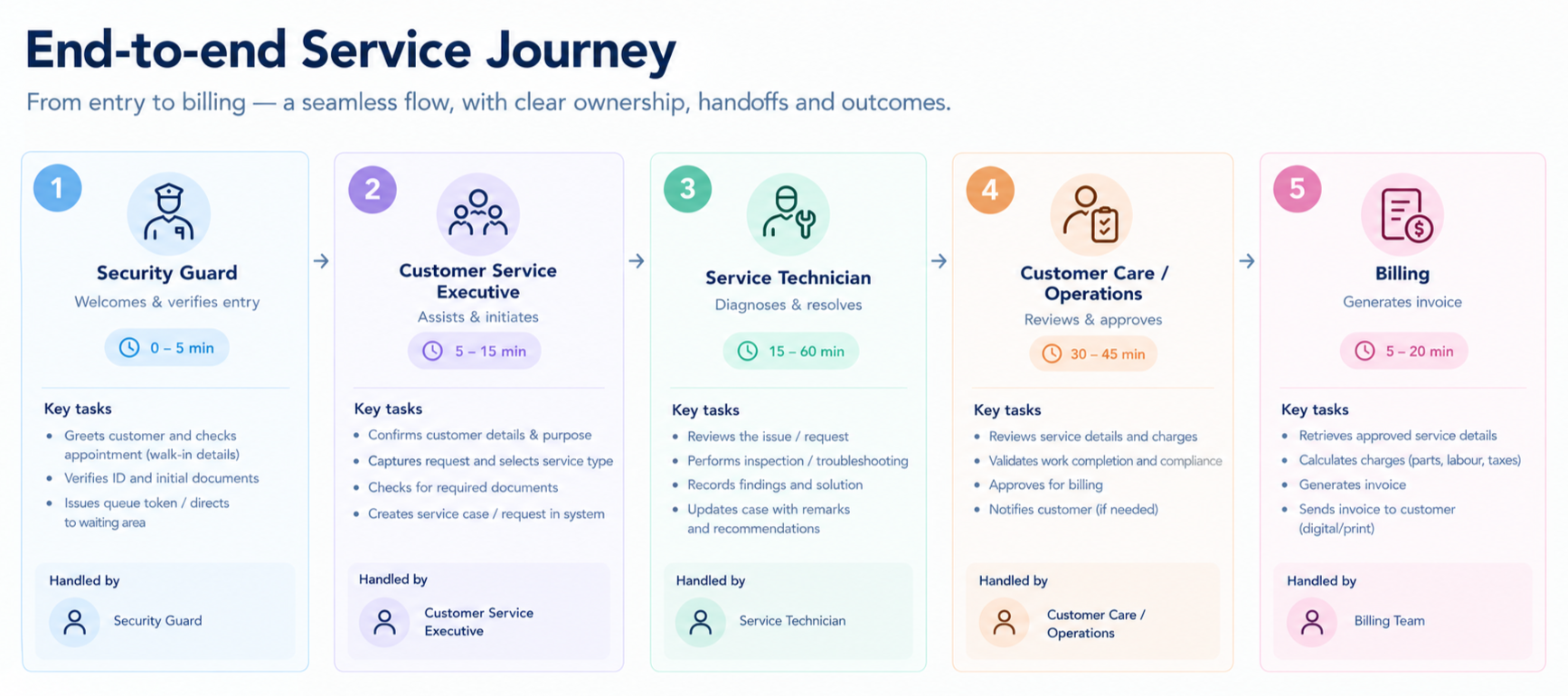
Understanding the lifecycle of a Service Station
Challenges
01
High workload & inefficient task management
Managing tight deadlines, high volumes, and technician allocation inefficiencies creates stress, potential service quality gaps, and operational bottlenecks.
02
Complex vehicle systems & technical challenges
Diagnosing and repairing modern vehicles has become an increasingly complex and time-intensive process, driven by rapid advancements in automotive technology.
03
Manual documentation & record keeping
Paper-based job cards, invoices, and service records are tedious, error-prone, and slow down operations with unreliable diagnostic methods
04
Communication & digital adoption gaps
Manual customer communication, poor inter-team coordination, and the learning curve for digital tools delay service completion and hinder efficiency.
Two wheeler workshop service - Bottle Neck Mapping
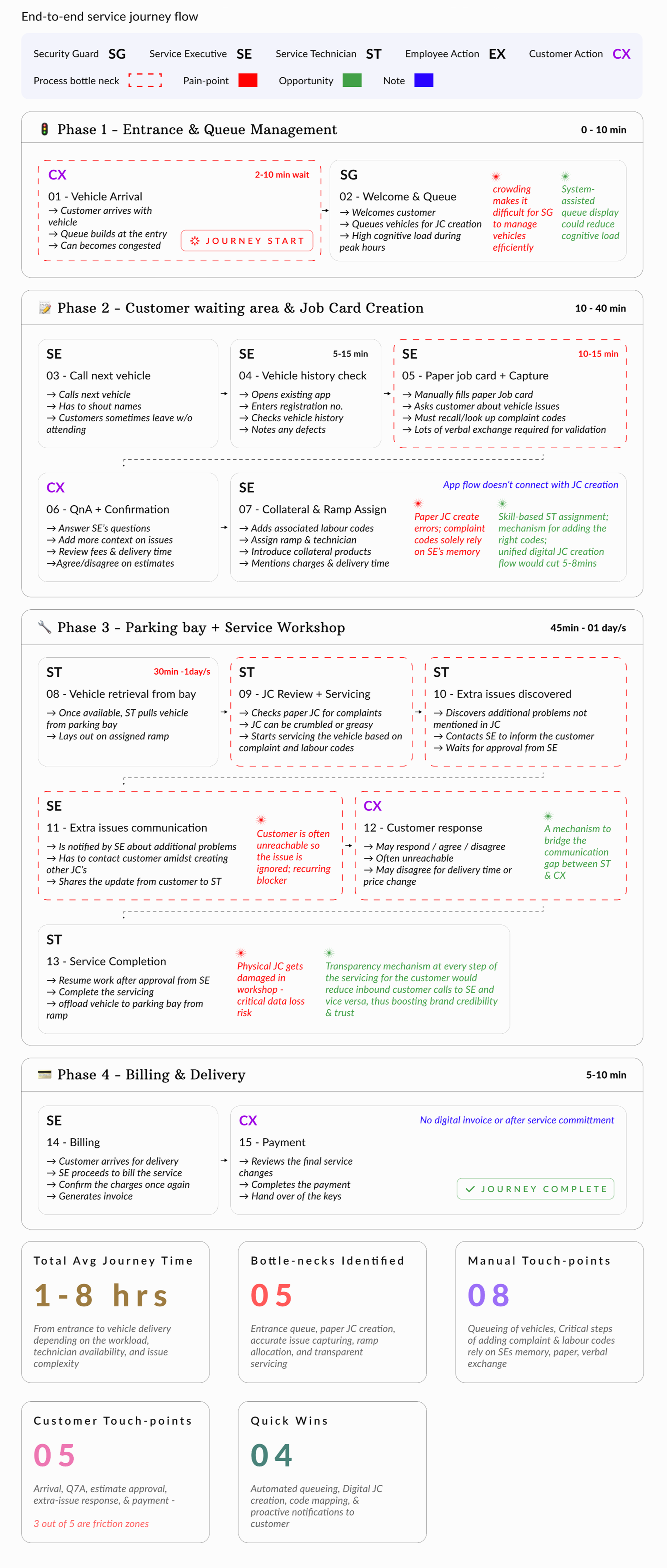
Once we had mapped and understood the existing end-to-end process, we plotted key themes that could drive our design strategy and direction.
The Service Executive is the focal point of the entire process, connecting all the trajectories. He/She has to overlook the tokens, billings, appointment of the Technician, and connecting with the customers post servicing.
This creates a tension of workload on the SE and it increases furthermore on the days of influx of customers, thus making the most important actor of the journey a bottleneck.
The process is dependent on manual interventions of the actors. Tokenisation cant happen without hte SG and SE, the part allocation cannot happen without the SE, the billing also needs intervention from the SE.
These are the moments that can be delegated to automation, which can reduce the overall servicing time and increase the customer retention rate.
Design Strategy for digitisation and building of the Holistic Digital App
Based on the newly developed service blueprint, we brainstormed a concept model to define foundational experience touch-points, anchored on four pillars of efficiency and growth - these pillars were also aligned with the core functions of the existing application’s workflow. These 4 pillars are :
Performance
Enterprise Growth
Transparency
Empowerment
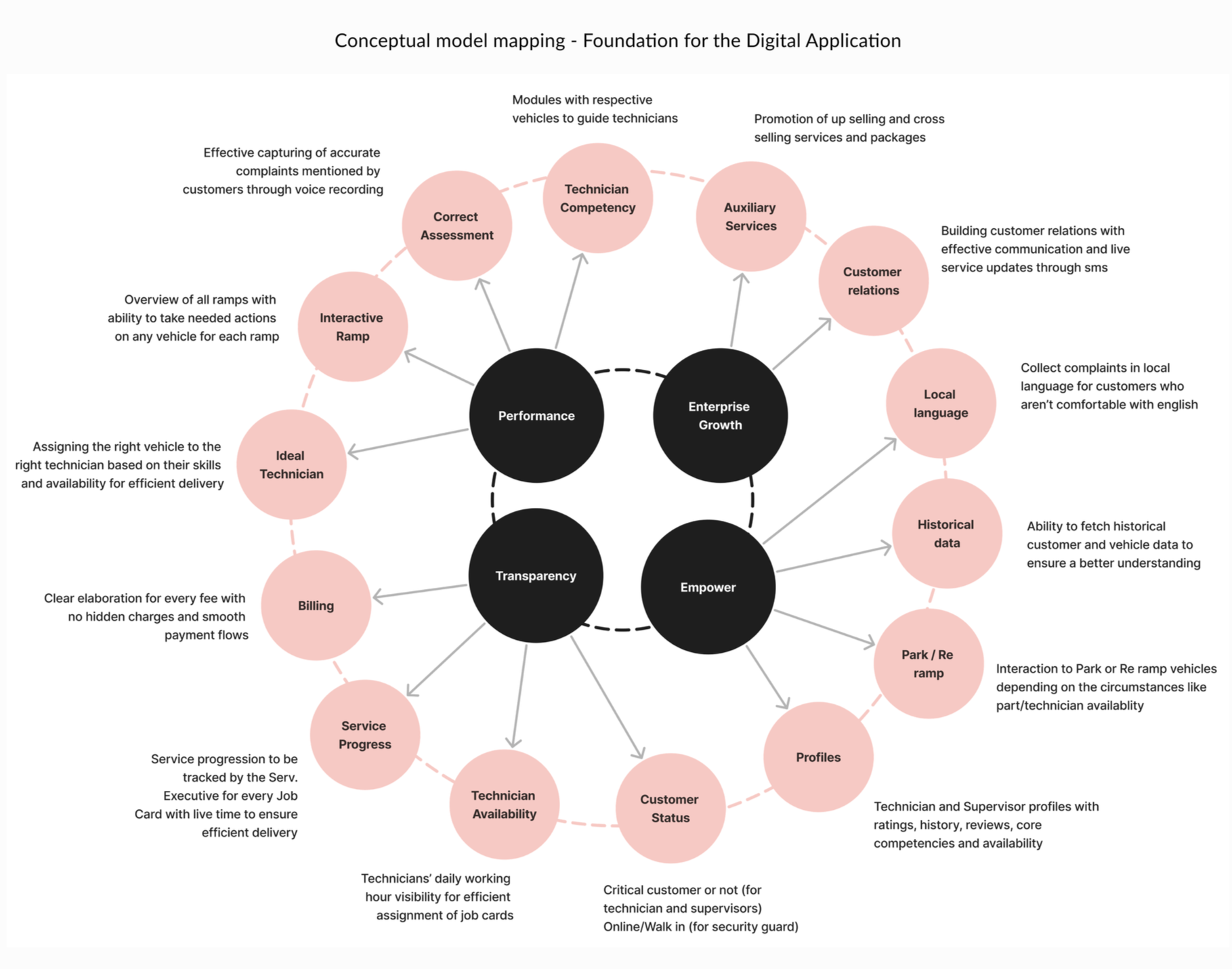
Architecture of the newly proposed service workflow
Once we were off our drawing boards and creative thinking hats, finalising the new workflows and customer touch-points - we drafted a one stop service blueprint to clearly communicate our end-to-end resolutions for the bottle-necks and re-build the servicing process holistically.
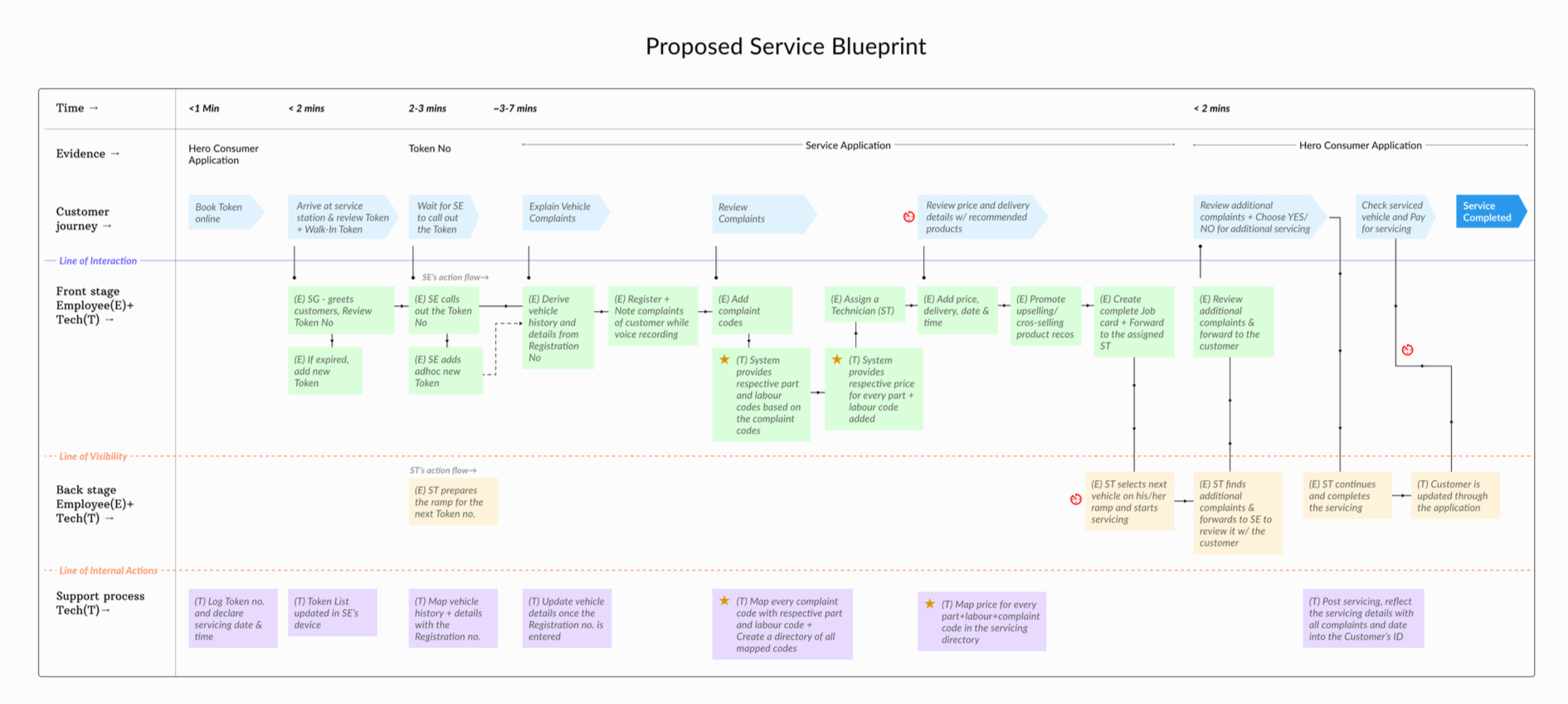
While we explored restructuring the overall workflow, our primary intervention focused on reducing service requirement gathering time by digitizing Job Card (JC) creation and assignment. Given the constraint of minimal changes to existing practices, bottleneck mapping across the customer journey led us to three key solution directions.
Design Outcomes
01
Tokenisation (Security Guard)
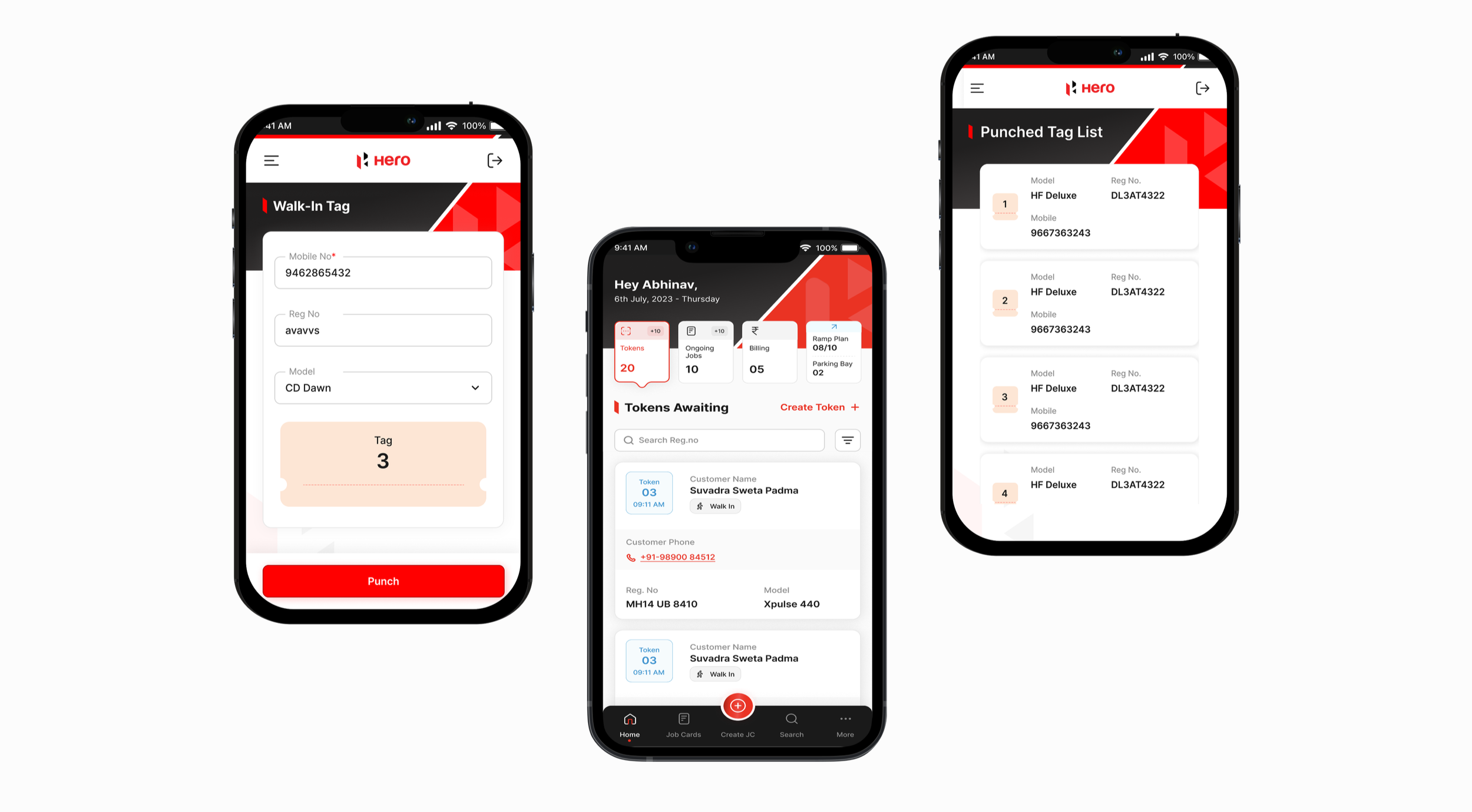
Proposed Resolution
→ Managed by the Security Guard (SG), each customer vehicle will be issued a token (TAG) as a queueing mechanism to reduce wait times and prevent crowding at the service station. For walk-in customers, the security guard will assign tokens upon arrival. For online bookings, tokens will be automatically generated by the system and integrated with the portal. One caveat observed was the SG’s technology learning curve.
02
Digital JC Creation and Technician Assignment (Service Executive)
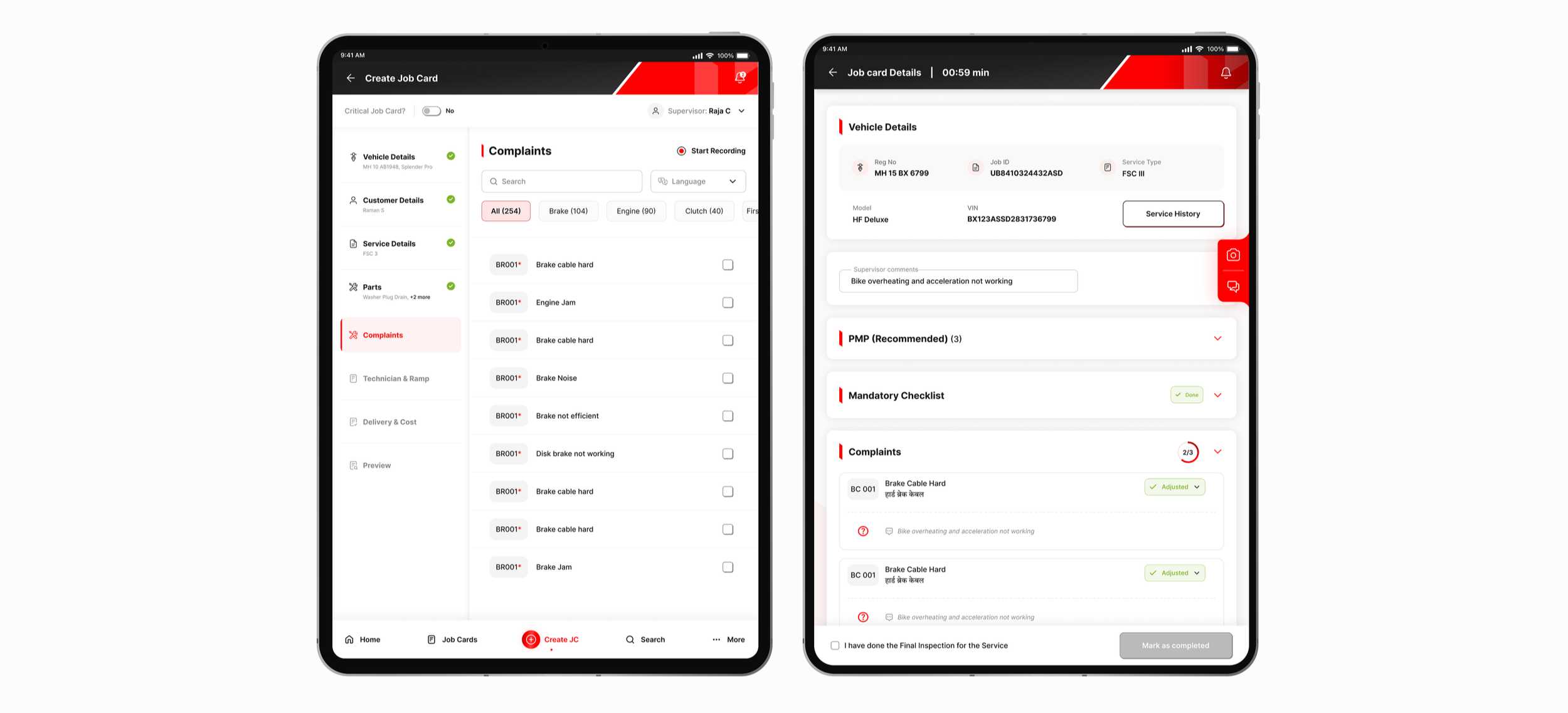
Proposed Resolution - A
→ Managed by the Service Executive (SE), the creation of the JC is the core JTBD within the workflow. Although an outdated mobile app currently supports critical actions in this process, we focused on designing a holistic & seamless application flow which revolved around 3-4 key sub-interventions accompanied by the complete digitisation of the process.
→ A. Inventory inter-tagging of codes - The backend process relied heavily on manual mapping, linking customer complaints to complaint codes, and subsequently mapping those codes to relevant parts and labour codes, making it time-consuming and error-prone. We proposed digitizing this logic by pre-programming and tagging complaint codes to corresponding parts and labour codes within the backend system.
→ This would enable the SE to simply record the customer complaint, after which the system would suggest the appropriate complaint codes. Once the correct complaint code is added to the JC, the system would map the required parts and labour codes, eliminating the need for manual search and entry. The caveat here was the efforts needed to program the mapping.
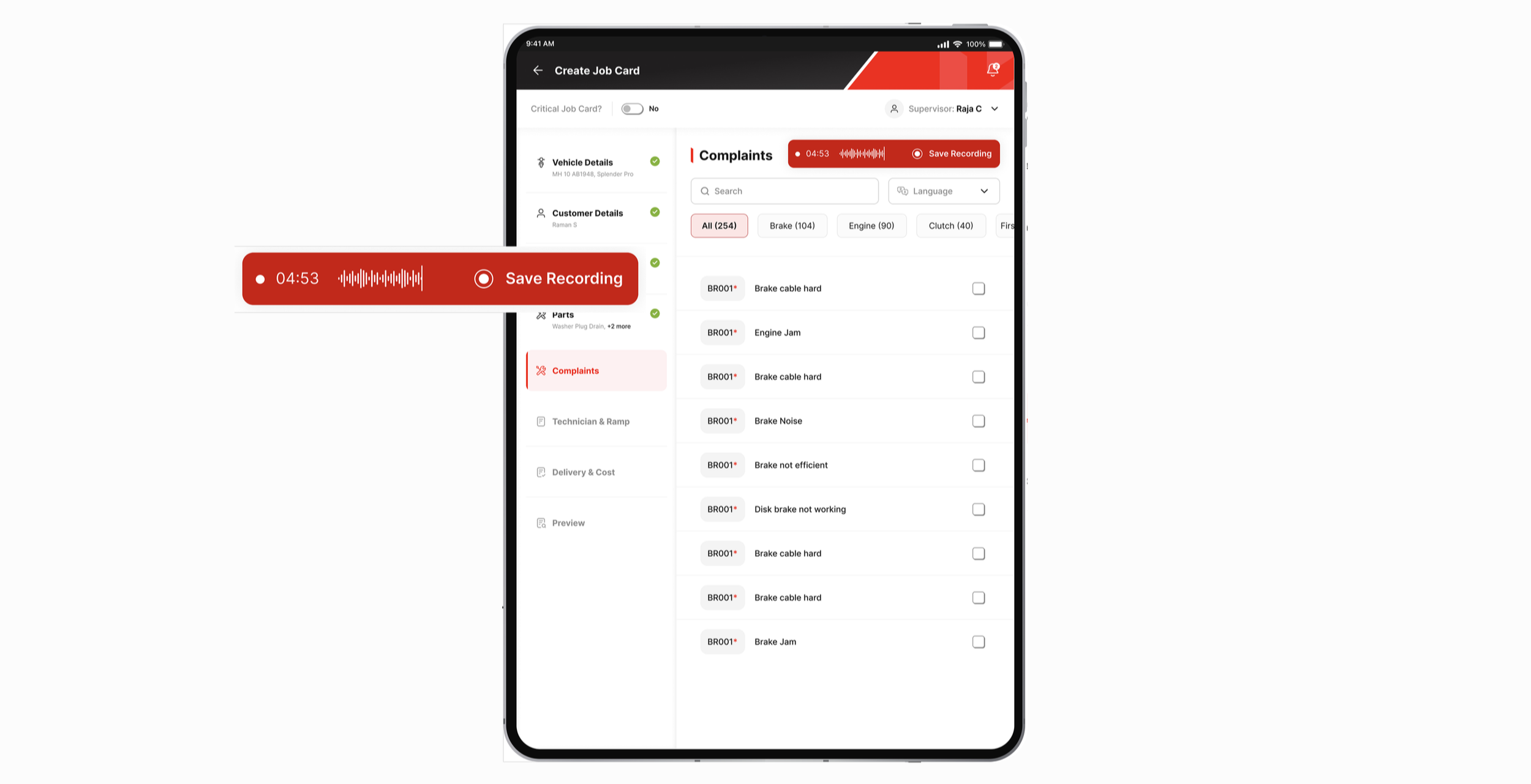
Proposed Resolution - B
→ B. Voice Recording - Building on the existing digitization of JC creation, we introduced an additional touchpoint that enables the SE to voice-record customer complaints (with their consent) and seamlessly share them with the Service Technician through the connected digital workflow.
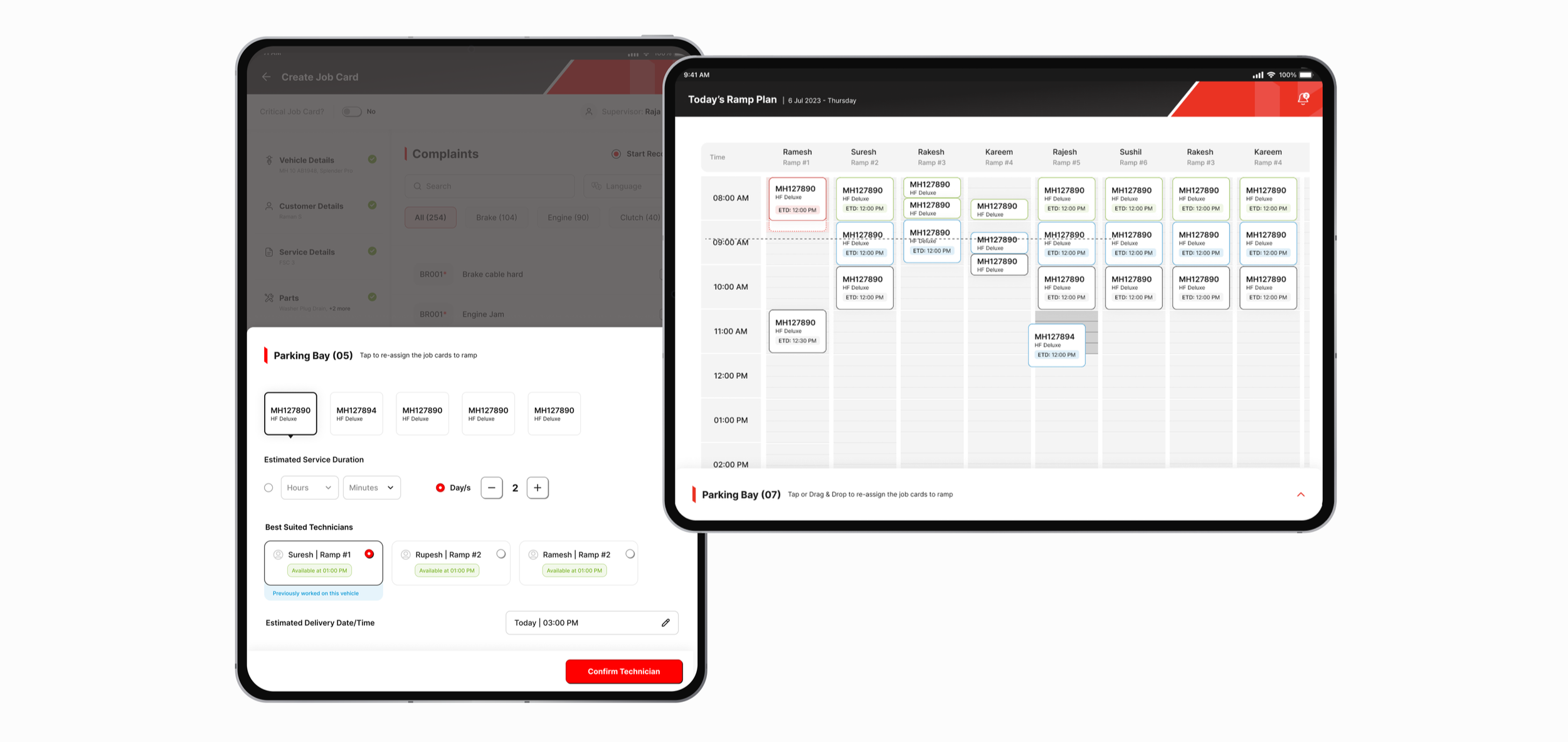
Proposed Resolution - C
→ C. Intelligent Ramp Allocation and Technician Assignment - An intelligent allocation logic was designed to assign ramps based on technician availability, timing, and specialized skill sets. This aims to improve service efficiency by reducing ramp wait times and vehicle queuing.
→ Based on this logic, technicians are assigned to specific ramps and vehicles according to the nature of the complaints and their specialized skill sets.
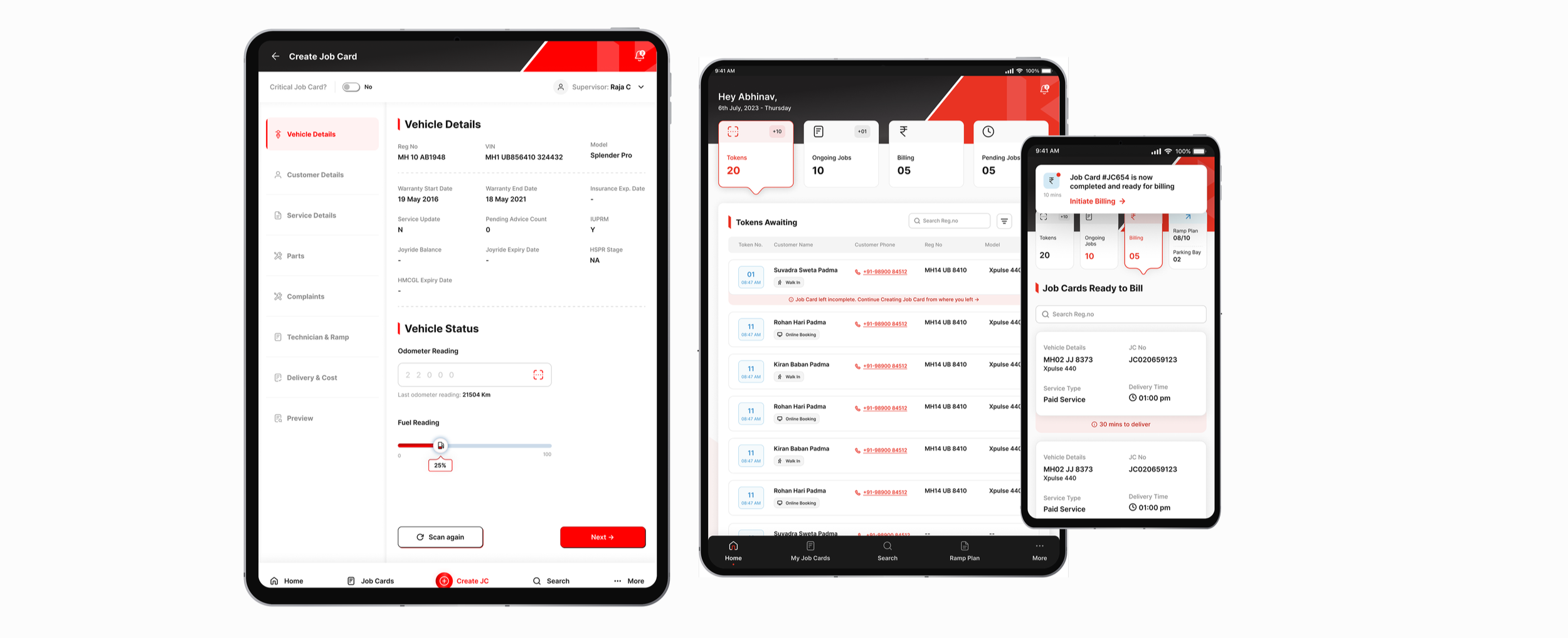
Proposed Resolution - D
→ D. Others - The client confirmed that each vehicle’s registration no. is recorded in their backend database. We therefore incorporated vehicle registration capture into the process as a key metadata parameter, enabling the SE to quickly access vehicle history for faster and more accurate diagnosis.
→ Towards the completion of the JC, a trigger-based integration was introduced as a touchpoint enabling the SE to recommend relevant after-sales services tailored to the specific customer.
03
Transparent Servicing (Service Technician)
Proposed Resolution
→ Managed by the Service Technician (ST), the servicing process was chaotic and lacked transparency for customers, reducing trust in the brand. It also led the STs to rely on manual, paper-based methods to track tasks for each job.
→ This led us to design a technician facing extension of the application that consolidates all details related to the assigned JC for a specific ramp or technician. By introducing a checklist-based live service tracking system with the ST as the primary user, the Service Executive can monitor the progress of each ongoing JC in real time.
→ To enhance customer transparency, the extension enables the ST to send critical updates or price change notifications during servicing to the customer via SMS or WhatsApp, allowing customers to stay informed and actively involved in the process.
Impact of our Resolutions
Due to the short engagement & costing concerns, we tried measuring estimated impact with smaller sample size than recommended. Hence, all figures are therefore approximates.
01
Improved Customer Experience
→ Redesigned service journeys with real-time updates on progress and charges increased transparency and trust, contributing to a 23% rise in after-sales registrations and cross-sell uptake.
02
Faster Workflow & Automation
→ Re-vamped technician workflows reduced manual documentation and communication from 10 minutes to 2 minutes per vehicle, saving significant staff time.
03
Reduced Key-Task Time
→ New digital job card and ramp allocation flows cut service preparation and technician assignment time by 5–8 minutes per vehicle, improving operational efficiency.
04
Reduced Error Rate
→ Voice-recorded complaint registration and technician modules decreased user errors by an estimated 20–25%, enhancing service accuracy.
To further enhance the customer-facing service experience, we undertook an additional exploration to reimagine the end-to-end journey by strategically integrating AI across key customer interactions.
What happens if AI intervenes..
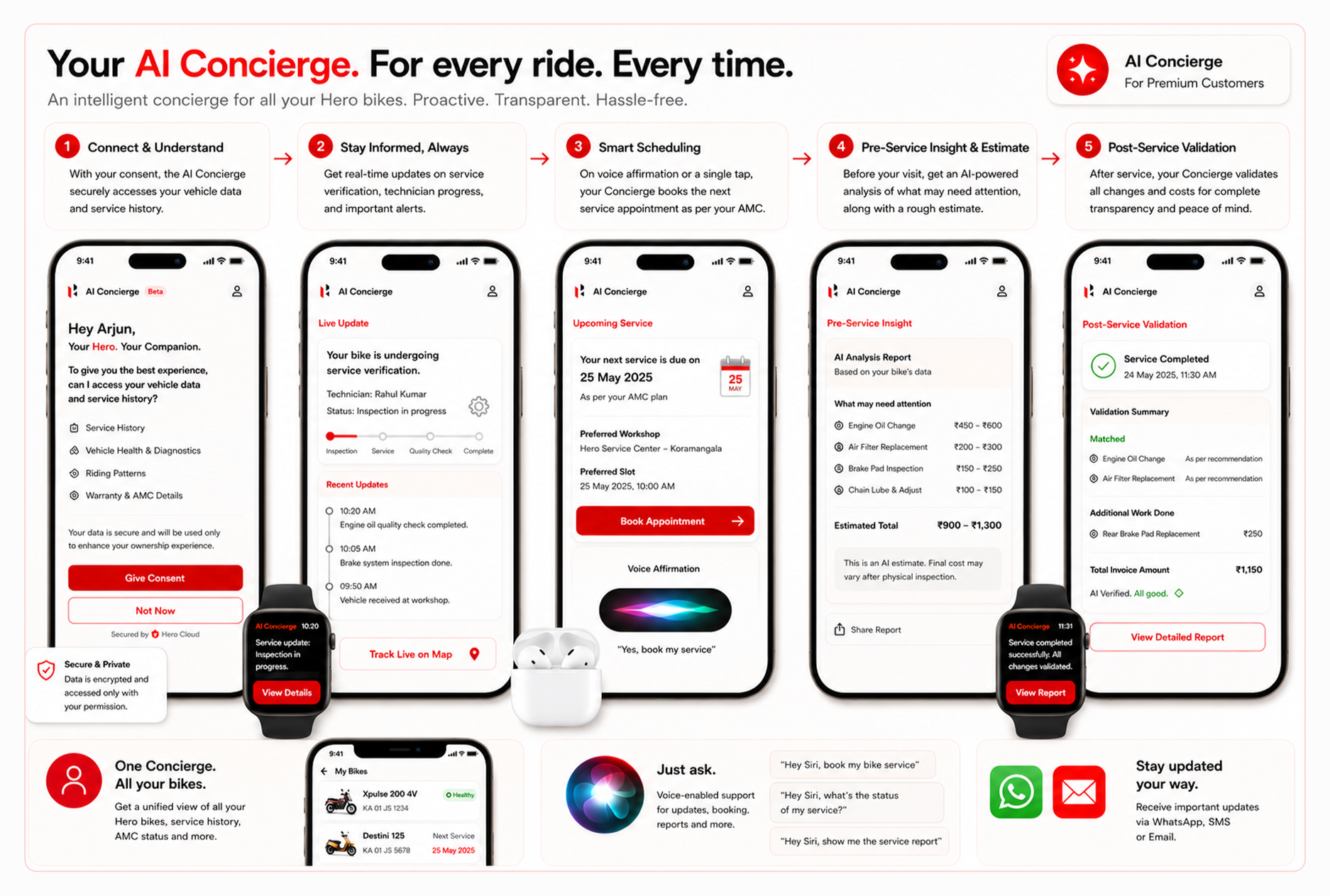
Introducing…
‘AI Service Concierge for Premium Hero MotoCorp Customers’
An intelligent service companion that leverages vehicle data and AI to simplify servicing, enhance transparency, and enable informed decision-making throughout the ownership journey.
01 - Connect & Understand
The AI Concierge securely accesses the rider's vehicle history, service records, and riding insights with customer consent.
02 - Stay proactively Informed
Customers receive timely updates on service due dates, appointment reminders, and real-time servicing progress.
03 - Book with a simple confirmation
Based on the customer's AMC and service schedule, the AI recommends an ideal service slot and books the appointment through a single tap or voice confirmation.
04 - Preview before you Service
Before the vehicle reaches the workshop, the AI generates a predictive health assessment, highlighting potential maintenance needs, recommended replacements, and an estimated service cost—helping customers make informed decisions.
05 - Service with complete Transparency
During servicing, the AI continuously tracks workshop progress, ensuring customers remain informed throughout the experience.
06 - Verify the Outcome
After servicing, the AI validates completed work by comparing workshop records, technician inputs, and vehicle sensor data against its initial assessment to ensure the service aligns with recommendations.
07 - Build Trust Through Transparency
Customers receive a clear service validation report detailing completed work, verified improvements, and a transparent cost breakdown, creating confidence in every service interaction.
More of my Work…
D2C Insurance Ecosystem transformation
A proposal for enabling innovative transformation of an insurance provider for omni-channel futuristic journey experiences.

In-house Service Design Capability Building
An initiative that enables organisations transform, with flexible and intentional service design interventions.